
Ausangate vs Huayhuash: Which Photography Trek to Choose?
Both Ausangate and Huayhuash offer mountain landscapes, glacial lakes, and opportunities for night photography. The better choice depends on the photographs you want, the time you have, and the walking itinerary you can comfortably undertake.
Photo tours peru
11/17/20268 min read
Ausangate vs Huayhuash: Which Photography Trek Is Right for You?
Both Ausangate and Huayhuash offer mountain landscapes, glacial lakes, and opportunities for night photography. The better choice depends on the photographs you want, the time you have, and the walking itinerary you can comfortably undertake.
Choose Ausangate when your wider journey is based around Cusco and you want to explore the Cordillera Vilcanota through a shorter or longer photography program. Choose Huayhuash when you want a dedicated multi-day mountain journey organized around high camps and lake landscapes, commonly from Huaraz.
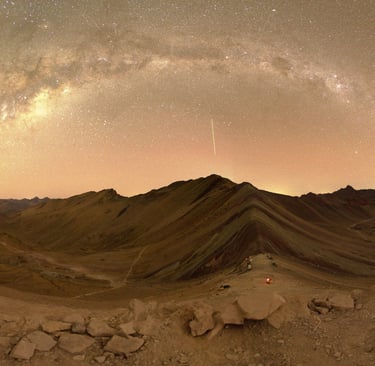
For astrophotography, neither destination wins automatically. The actual camp, mountain horizon, Moon, weather, and time available after dark matter more than the destination name.
This guide compares the two regions and explains how Milky Way and zodiacal-light photography can influence your decision.
Ausangate vs Huayhuash at a glance
Consideration Ausangate Huayhuash Region Cordillera Vilcanota, Cusco regionCordillera Huayhuash, across parts of Áncash, Huánuco, and Lima Common organizing base Cusco Huaraz Landscape interestsLakes, mountain massifs, highland valleys, and varied terrainLake-and-peak compositions, ridgelines, passes, and valleys Published Photo Tours Peru options Shorter programs and a six-day astrophotography expedition Eight- and nine-day photography treks Itinerary combinations Can fit a wider Cusco journey Suits a dedicated mountain section Night photography Depends on exact site and dates Depends on exact site and dates Physical demands High-altitude walking; route-specific Demanding multi-day walking; route-specificBest decision method Compare the actual camps and daily stages Compare the actual camps and daily stages
This table is a planning comparison, not a claim that every route in either region has the same scenery or difficulty.
Which trek offers the landscapes you want?
Ausangate: varied high-Andean compositions
Ausangate suits photographers interested in working across lakes, broad valleys, mountain details, and changing weather.
A lake-focused excursion near Pacchanta provides a different experience from a multi-day trek. Selected itineraries also combine the wider region with Rainbow Mountain, but the route and access need to be confirmed.
Consider Ausangate if your portfolio goals include both broad landscapes and smaller details: shoreline patterns, reflections, mountain textures, and the relationship between the landscape and local life.
Huayhuash: a sustained mountain photography journey
Huayhuash is a strong choice when the trek itself is a major part of your trip.
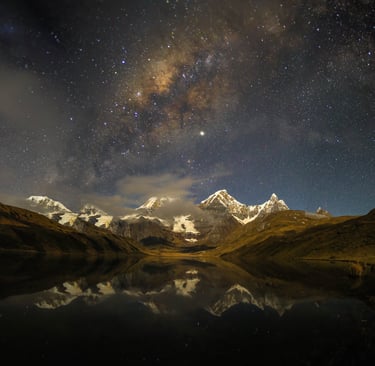
Carhuacocha and Jahuacocha are established lake settings, while selected routes also include Viconga. The value for photographers depends on when you arrive and how long you remain, not simply whether a lake appears in the itinerary.
A repeated night at a productive camp can give you another chance at reflections, sunrise, or a nightscape. Ask whether the program offers that flexibility.
Which is better for lake reflections?
Neither can guarantee still water.
Choose an itinerary that gives you enough time near the lake and alternative compositions when wind changes the surface. A shorter route with a well-timed session can be more useful than a longer route that reaches the shoreline just before leaving.
Which fits your travel schedule?
Ausangate is usually the more natural geographical fit for a journey already centered on Cusco, the Sacred Valley, and Machu Picchu.
Huayhuash is usually planned as a separate mountain section, commonly organized from Huaraz. Allow for the travel needed to reach the base and trailhead, preparation days, and the return journey.
Do not compare only the advertised number of trekking days. Ask what happens before and after the trek.
Question Why it matters Where does the package begin and end?Establishes what transport is included Are preparation days included?Affects the complete travel schedule How long are the walking stages?Determines energy and arrival timeHow many nights are spent near priority subjects?Determines repeat opportunities Are nights at the same camp possible?Can provide weather and composition flexibility
Ausangate vs Huayhuash: which is harder?
There is no reliable difficulty ranking without comparing two specific routes.
Both destinations involve high-elevation conditions. A shorter Ausangate program can still be demanding, while a longer Huayhuash trek requires sustained walking and camp routines.
Compare:
Highest pass and sleeping elevations.
Daily ascent and descent.
Trail surface and exposure.
Walking hours with photography stops.
Equipment you carry personally.
Preparation, support, and contingency arrangements.
Discuss your previous trekking experience and walking preferences before booking. Photography ability does not determine trekking suitability.
Best time for landscape photography
For a first comparison, April through November offers a useful overlap between commonly recommended Andean trekking periods.
Official Huayhuash tourism guidance identifies May to September as a recommended window. In the southern Andes, relatively dry conditions broadly extend through much of May to October.
These are regional planning patterns, not a ranking of which range will have better weather on your dates.
Drier conditions can simplify travel and outdoor sessions. Changing clouds can create dramatic light, but may also obscure the peaks. Clear nights can be cold, and wind affects both comfort and camera stability.
Choose a season that suits the route, then allow flexibility within it.
Which trek is better for Milky Way photography?
Both can offer opportunities, but the camp and date decide the composition.
The bright galactic-center region is a seasonal target. A broad Southern Hemisphere planning window of roughly February to October is useful, with exact nighttime hours depending on date and location.
For either trek, the overlap between the relatively dry months and useful core visibility makes May through September worth considering.
Before selecting a route for a particular photograph, check:
Camp coordinates.
Mountain horizon in the direction of the core.
End of evening twilight and start of morning twilight.
Moonrise, moonset, and lunar illumination.
Walking access to the foreground.
The following day’s trekking demands.
A dark camp may still be unsuitable if a ridge blocks the intended alignment. More advertised nights do not automatically mean more usable astrophotography time.
Zodiacal light: another reason to plan your dates carefully
What is zodiacal light?
Zodiacal light is sunlight scattered by interplanetary dust. Under suitable conditions, it appears as a faint cone extending upward from the horizon along the ecliptic.
It is different from the Milky Way, ordinary twilight, and artificial light from a settlement.
Both Ausangate and Huayhuash may provide opportunities, but neither destination guarantees visibility.
When should you look in Peru?
Seasonal reference Direction and timing What your itinerary needs Around the September equinox West after evening twilight A suitable western opening and a Moon-free sessionAround the March equinox East before morning twilight A suitable eastern opening and a route workable in wetter conditionsOther datesDepends on local geometry Assessment of ecliptic angle, Moon, twilight, and terrain
These are favorable planning references rather than exclusive viewing periods. Both regions are at tropical latitudes, where opportunities can extend beyond the equinox months.
The exact mountain horizon matters. A camp with attractive peaks may hide much of the glow.
Is September a useful choice for both treks?
Yes, it is a practical month to consider because an evening zodiacal-light opportunity may overlap with generally favorable trekking-season planning.
However, evaluate the actual camps and dates. A route that reaches camp late or has an obstructed western horizon may not support the image you want.
What about March?
Around March, the eastern pre-dawn geometry can be favorable, but the period overlaps the wetter Andean season.
Do not choose a demanding trek on the astronomical calendar alone. Discuss current access and operational suitability before committing to either destination.
Which region is better for zodiacal-light photography?
There is no defensible universal winner.
Prefer the itinerary that provides a suitable eastern or western horizon, manageable access after dark, time for the session, and acceptable local conditions.
Do not select a destination because of an unsupported claim of “zero light pollution” or a precise Bortle rating.
How to photograph zodiacal light
Use a wide-angle lens, stable tripod, manual exposure, RAW capture, and accurate focus on a star.
Begin with a test exposure. Confirm the expected direction, wait for an appropriate level of darkness, and identify competing artificial light.
A faint glow near the horizon should not be labeled zodiacal light without checking shape and geometry.
If you want to include it with the Milky Way, plan the combined field of view for the actual date. A panorama may help, but it requires practice and more time outdoors.
Camera equipment for either trek
The equipment needs are similar. The important difference is how much you can comfortably carry on the chosen route.
A practical kit may include:
Wide-angle lens for broad landscapes and night skies.
Standard zoom for flexible framing.
Optional telephoto for mountain details.
Stable tripod suited to your setup.
Spare batteries, memory cards, and a backup plan.
Weather protection and lens cloths.
Headlamp and a backup light.
A maximum aperture around f/2.8 or wider is useful for night photography. A star tracker is optional and adds weight and setup time.
Ask which equipment the support team transports and what remains in your daypack. Confirm charging arrangements rather than assuming power is available at camp.
Starting settings for landscapes and night skies
Subject Starting approach Daylight landscape Low ISO when appropriate, around f/8, and shutter matched to conditions Lake reflection Shutter selected for the water effect you wantBlue hourTripod and careful exposure review Untracked Milky WayApproximately 8–15 seconds, f/1.8–f/2.8, ISO around 1600–6400 Zodiacal light Similar initial wide-field settings, adjusted for the faint glow and twilight
These are examples to test. Camera resolution, focal length, sky position, and final output affect acceptable exposure times.
Magnify a star to focus rather than trusting the infinity mark. Inspect a test frame for trailing, blur, and exposure before beginning a sequence.
Compare photographic value rather than price alone
Request itemized proposals for the actual route and group size.
Compare guiding, transport, camp equipment, meals, access arrangements, support staff, and photography time. A package that costs less may include fewer useful sessions or different logistics.
Ask whether night photography support is part of the itinerary or simply an activity you may attempt independently.
The relevant question is what each proposal enables you to photograph, within a route that suits you.
Which photography trek should you choose?
Choose Ausangate if:
Your trip is centered on Cusco.
You want to compare shorter and longer regional programs.
You are interested in a combination of lakes, mountain textures, and Andean landscapes.
You want to discuss an itinerary combining the region with Rainbow Mountain.
Choose Huayhuash if:
You want a dedicated multi-day mountain journey.
Carhuacocha, Jahuacocha, or a route through Viconga are priorities.
You can allocate time for the trekking schedule and travel around it.
You value a route with productive camps and opportunities to revisit scenes.
If night skies are your main priority:
Choose after evaluating camp horizons, Moon-free hours, season, access, and the balance between walking and rest. Neither range can guarantee the image.
Frequently asked questions
Is Ausangate easier than Huayhuash?
Not automatically. Compare specific daily stages, sleeping elevations, passes, support, and equipment weight.
Can beginners join these photography treks?
Photography beginners can participate when the trekking demands suit them. Learn camera basics beforehand and discuss physical preparation with the operator.
Can I photograph zodiacal light in both regions?
Potentially, with suitable darkness, geometry, weather, and horizons. It should be planned as an opportunity rather than a guaranteed session.
Can I combine both treks in one trip?
Yes in principle, but they require separate travel arrangements and enough time for preparation, trekking, and rest. Ask for a complete schedule rather than adding the advertised trek lengths together.
Which is better for a shorter Cusco-based holiday?
Ausangate is generally the more convenient geographical fit. The exact program still needs to suit your available time and walking experience.
Are clear skies guaranteed in the dry season?
No. Weather patterns help planning but cannot determine conditions on a particular night.
Plan your photography trek with Photo Tours Peru
Tell us your dates, group size, camera equipment, previous trekking experience, and the photographs you hope to create.
Explore:
Contact Photo Tours Peru for a comparison built around your priorities: mountain light, lake reflections, the Milky Way, or zodiacal light.


Contact
Email: phototourperu@gmail.com
Phone: +51 940188346
© 2025. All rights reserved.
Designed by Zihna