
Huayhuash Photography Trek – 9-Day Landscape & Astrophotography Expedition
Trek Overview Huayhuash Photography Trek workshop 2027
Home / Huayhuash Photography Trek via Viconga 9 Day
Huayhuash Landscape & Astrophotography Trek – 9 Days
A photography-focused expedition through Peru’s Cordillera Huayhuash, combining dramatic mountain landscapes, glacial lakes, sunrise and sunset photography, and opportunities to photograph the Milky Way beneath dark Andean skies.
Explore one of Peru’s most spectacular mountain ranges on a 9-day Huayhuash photography trek designed for landscape photographers, astrophotographers, and adventurous travelers who want to spend more time creating photographs in the field.
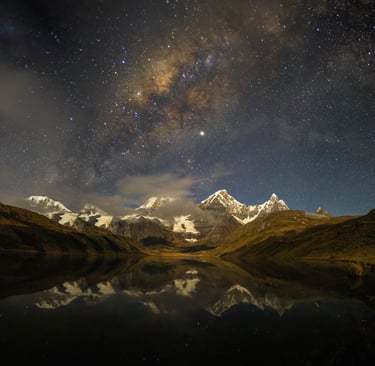
This expedition follows a challenging high-altitude route through the Cordillera Huayhuash, with opportunities to photograph Laguna Carhuacocha, Laguna Viconga, Laguna Jahuacocha, dramatic mountain passes, remote valleys, and snow-covered Andean peaks.
Unlike a standard trekking tour, this photography expedition considers the light, weather, landscape, and night sky when planning photographic opportunities. You will have opportunities to work on compositions during sunrise, sunset, blue hour, and, when conditions permit, Milky Way photography and star trails.
With guidance from a professional photographer-guide and support from a local trekking team, you can develop your landscape photography skills while exploring one of the Andes’ most impressive mountain environments.
Duration: 9 days / 8 nights, subject to the final accommodation and route plan
Destination: Cordillera Huayhuash, Ancash, Peru
Starting point: Huaraz
Tour style: Small-group or private photography expedition, as confirmed
Photography focus: Landscape photography, astrophotography, nightscapes, and Andean travel photography
Accommodation: Camping during the trekking expedition
Difficulty: Challenging high-altitude trek
Meals: Breakfast, lunch, and dinner during the trekking section, according to the confirmed meal plan
Why Choose Our Huayhuash Photography Trek?
Photograph the Cordillera Huayhuash
Photograph towering peaks, turquoise glacial lakes, rugged ridgelines, remote Andean valleys, and the changing light of the high mountains. Huayhuash offers opportunities for wide-angle landscapes, telephoto mountain details, panoramas, and compositions that combine foreground elements with dramatic mountain scenery.
Explore Carhuacocha, Viconga, and Jahuacocha
The itinerary includes time in some of the region’s best-known landscape settings. Depending on weather and route conditions, these locations can provide opportunities for mountain reflections, sunrise photography, sunset light, and night-sky compositions.
Develop Your Astrophotography Skills
Selected camps may offer opportunities to photograph the Milky Way, star trails, and mountain nightscapes. Your photographer-guide can provide practical guidance on manual exposure, focusing in low light, tripod technique, and foreground composition.
Night-sky results depend on the moon phase, season, cloud cover, and visibility. Specific astronomical photographs cannot be guaranteed.
Learn Through Field Photography
Photography guidance takes place in the landscape itself. Work on composition, exposure, lens selection, panoramic photography, and reading changing light while developing your own approach to mountain photography.
Experience a Remote High-Altitude Trek
This is a demanding mountain expedition, not a vehicle-based sightseeing tour. The route involves long hiking days, remote camps, uneven terrain, and high mountain passes. Proper acclimatization and physical preparation are essential.
What Will You Photograph in Huayhuash?
Mountain Landscape Photography
Snow-covered peaks and glacial mountain scenery.
Turquoise alpine lakes and possible mountain reflections.
Mountain passes, ridgelines, and expansive Andean panoramas.
Rock formations, grasslands, and foreground details.
Atmospheric landscapes shaped by changing mountain weather.
Astrophotography and Night Landscapes
Milky Way compositions over the Andes, when visible.
Star trails above mountain silhouettes.
Long-exposure nightscapes.
Moonlit mountain scenes.
Campsite and tent compositions, where appropriate and permitted.
Twilight transitions from blue hour to night.
Sunrise, Sunset, and Blue Hour
First light on snow-covered peaks.
Sunset colors across mountain ridgelines.
Alpine lake reflections when water and weather conditions permit.
Panoramic compositions during changing light.
Telephoto details of mountain textures and atmospheric conditions.
9-Day Huayhuash Photography Trek Itinerary
Day 1: Huaraz – Huánuco Pampa – Queropalca
Photography focus: Andean landscapes, archaeological scenery, rural environments, and night photography.
Depart Huaraz and travel toward the Cordillera Huayhuash through the highlands of Ancash and neighboring Andean regions. Subject to the confirmed transport route and opening conditions, stop at Huánuco Pampa to photograph its archaeological landscape and the relationship between Inca architecture and the surrounding mountains.
Continue toward Queropalca, where you will prepare for the trekking section.
If time, weather, and access allow, the evening may offer an opportunity for introductory nightscape photography.
Photography opportunities: Wide-angle landscapes, archaeological details, rural scenery, mountain silhouettes, and stars if conditions are suitable.
Overnight: Queropalca, in the accommodation confirmed for the departure.
Meals: As specified in the final departure plan.
Day 2: Queropalca – Laguna Carhuacocha
Photography focus: Alpine lakes, mountain reflections, and sunset landscapes.
After breakfast, travel or trek toward Laguna Carhuacocha according to the confirmed route and trail conditions. This celebrated landscape features a high-altitude lake framed by imposing Andean peaks.
Once at camp, explore suitable viewpoints and identify foregrounds, reflections, and mountain compositions for the afternoon and evening.
As the light changes, work on exposure, framing, and foreground selection. If the sky is clear and the moon and Milky Way position are favorable, the evening may provide an opportunity for astrophotography.
Photography opportunities: Mountain reflections, glacial peaks, panoramic landscapes, sunset light, and possible night-sky photography.
Overnight: Camping near Laguna Carhuacocha, subject to the final route.
Meals: Breakfast, lunch, and dinner during the trekking program.
Day 3: Laguna Carhuacocha – Full-Day Landscape Photography
Photography focus: Sunrise, lake reflections, mountain details, and nightscapes.
Dedicate additional time to Carhuacocha rather than immediately moving to another camp. This extended photography day allows you to explore different viewpoints and work with changing light.
Begin with a sunrise session when weather and access permit. During the day, explore the lakeshore and nearby viewpoints, looking for foreground rocks, reflections, layered peaks, and telephoto compositions.
The afternoon provides time to review compositions and prepare for sunset and blue hour. If conditions allow, finish with a night-sky photography session.
Photography opportunities: Sunrise reflections, panoramic mountain views, long exposures, telephoto landscapes, blue hour, and Milky Way photography when visible.
Overnight: Camping at or near the confirmed Carhuacocha campsite.
Meals: Breakfast, lunch, and dinner.
Day 4: Carhuacocha – Siula Pass Area – Huayhuash Camp
Photography focus: High mountain passes, alpine lakes, glaciers, and panoramic landscapes.
Continue along the high-altitude trekking route toward the Siula Pass area. This is a demanding day with sustained walking and changes in elevation.
The route provides opportunities to photograph glacial lakes, rugged ridgelines, mountain textures, and broad views across the Huayhuash range. A wide-angle lens is useful for expansive compositions, while a telephoto lens can isolate distant peaks and details.
The walking time is estimated at approximately 7–8 hours, depending on the confirmed route, weather, and group pace.
Photography opportunities: High-pass panoramas, layered peaks, alpine lakes, glacial scenery, and atmospheric mountain conditions.
Overnight: Camping at the designated Huayhuash campsite.
Meals: Breakfast, lunch, and dinner.
Day 5: Huayhuash Camp – Laguna Viconga
Photography focus: High-Andean landscapes, mountain textures, and night photography.
Continue through remote Andean terrain toward Laguna Viconga. The landscape offers opportunities to photograph broad mountain scenery, grasslands, rock formations, and changing weather.
After reaching camp, use the available time to explore safe nearby viewpoints and prepare compositions for sunset.
If the night is clear and astronomical conditions are suitable, photograph the stars or Milky Way above the surrounding mountains.
Photography opportunities: Wide-angle landscapes, telephoto mountain details, possible wildlife sightings, and nightscapes.
Overnight: Camping near Laguna Viconga.
Meals: Breakfast, lunch, and dinner.
Day 6: Laguna Viconga – San Antonio Viewpoint Area – Pampa Elefante
Photography focus: Mountain panoramas, high-Andean terrain, and atmospheric landscapes.
Continue toward the San Antonio viewpoint area and Pampa Elefante, following the confirmed trekking route. The day's landscape changes between open mountain terrain, rugged ridgelines, and broad views of the surrounding Andes.
Photographers can work with leading lines, layers of mountains, changing cloud formations, and foreground details. When weather and safe access allow, selected viewpoints may offer expansive compositions across the range.
The approximate walking time is 6–7 hours, subject to the final route and conditions.
Photography opportunities: Panoramas, dramatic clouds, mountain silhouettes, Andean grasslands, and night photography if the sky is clear.
Overnight: Camping at Pampa Elefante or the designated campsite.
Meals: Breakfast, lunch, and dinner.
Day 7: Pampa Elefante – Huayllapa – Huatiaj
Photography focus: Andean valleys, mountain scenery, and rural landscapes.
Continue through the mountain valleys toward Huayllapa and the planned Huatiaj campsite, according to the confirmed trekking route.
The landscape provides opportunities to photograph the contrast between steep mountain slopes, open valleys, grasslands, and rural environments. Where appropriate, use a standard zoom or telephoto lens to create more intimate landscape compositions.
The route may involve a long trekking day, so photography stops will be balanced with safety, trail conditions, and the group's pace.
At camp, prepare for sunset and, if conditions permit, a night-sky session.
Photography opportunities: Valley panoramas, layered mountain compositions, rural scenery, sunset light, and possible star trails.
Overnight: Camping at the designated Huatiaj campsite.
Meals: Breakfast, lunch, and dinner.
Day 8: Huatiaj – Laguna Jahuacocha
Photography focus: Mountain panoramas, lake reflections, and sunset photography.
Continue toward Laguna Jahuacocha, another notable landscape setting in the Huayhuash region. The route offers changing perspectives of the surrounding mountains and valleys.
After reaching camp, explore suitable lakeside viewpoints and prepare compositions for the afternoon and evening. If the water is calm, reflections may add symmetry to mountain scenes.
When weather and astronomical conditions are favorable, the lake and mountain silhouettes may also provide a foreground for night photography.
Photography opportunities: Alpine lake compositions, mountain reflections, panoramic landscapes, sunset, blue hour, and possible Milky Way photography.
Overnight: Camping near Laguna Jahuacocha.
Meals: Breakfast, lunch, and dinner.
Day 9: Laguna Jahuacocha – Llamac – Huaraz
Photography focus: Sunrise, final mountain landscapes, and Andean scenery.
Begin with a final sunrise photography session around Laguna Jahuacocha, if weather and access allow.
After breakfast, descend toward Llamac, photographing the changing landscape as the high mountains give way to lower valleys and rural scenery.
From Llamac, travel by vehicle back to Huaraz. Arrival time depends on trail conditions, road conditions, and transport arrangements.
Photography opportunities: Final lake reflections, mountain panoramas, rural landscapes, and environmental photographs along the return route.
Meals: Breakfast and any additional meals specified in the confirmed transport plan.
End of the Huayhuash Landscape & Astrophotography Trek.
What's Included in the Huayhuash Photography Trek?
Included Services
The final booking confirmation should specify the following services included in your selected departure:
Nine-day Huayhuash photography expedition.
Professional photographer-guide or photography instructor as confirmed.
Local trekking guide and trekking support team.
Scheduled ground transportation from Huaraz to the trailhead and back to Huaraz.
Camping accommodation during the trekking section.
Tents and shared camping equipment supplied by the operator, as specified in the final equipment list.
Breakfast, lunch, and dinner during the trekking section, according to the confirmed meal plan.
Drinking water arrangements and water-treatment provisions as stated in the final itinerary.
Applicable trekking permits and entrance fees listed in the confirmed quotation.
Pack animals or porter support for shared group equipment, as specified in the final proposal.
Field photography guidance covering composition, exposure, landscape photography, and astrophotography techniques.
Please confirm which personal equipment must be carried by each participant and which items are supplied by the trekking team.
What's Not Included?
Unless explicitly stated in the final written quotation, the following are not included:
International flights and domestic flights.
Accommodation in Huaraz before or after the trek.
Meals in Huaraz and meals outside the included trekking meal plan.
Personal camera bodies, lenses, tripods, filters, and photography accessories.
Personal trekking clothing, hiking boots, sleeping bag, and other personal equipment unless specified as supplied.
Travel insurance, medical expenses, and emergency evacuation coverage.
Personal expenses, snacks, alcoholic beverages, and drinks not specified as included.
Tips for guides, drivers, cooks, and trekking staff.
Additional hotel nights caused by early arrival, late departure, or changes outside the agreed itinerary.
Single-room supplements or private camping upgrades, if requested and available.
Any additional service not explicitly listed in the final quotation.
Huayhuash Photography Trek Pricing
We offer pricing based on the number of travelers and the confirmed service arrangements.
Your quotation should clearly state whether the departure is a small-group tour or a fully private expedition. Private departures may require a different price because the vehicle, guide, photographer-guide, and trekking team are allocated to your party.
The price includes only the services specified in the final quotation. Before booking, request confirmation of meals, transportation, permits, camping equipment, luggage support, and photography-guide arrangements.
Best Time for Landscape and Astrophotography in Huayhuash
The drier months are generally preferred for trekking in the Cordillera Huayhuash, although mountain weather can change rapidly and precipitation is possible throughout the year.
For astrophotography, travel dates should also be considered in relation to the moon phase and the seasonal position of the Milky Way. A dark sky does not guarantee a clear sky, and cloud cover can change quickly at high altitude.
We recommend planning your expedition around your photographic priorities, physical preparation, and the local operating conditions for your preferred dates.
Recommended Camera Equipment
Landscape Photography
DSLR or mirrorless camera.
Wide-angle lens for expansive mountain landscapes.
Standard zoom lens for flexible compositions.
Optional telephoto lens for mountain details and compressed perspectives.
Sturdy tripod for long exposures and low-light photography.
Polarizing filter where appropriate.
Astrophotography
Camera with manual exposure controls.
Fast wide-angle lens, ideally f/2.8 or faster.
Sturdy tripod.
Headlamp with a red-light mode.
Spare batteries and memory cards.
Remote shutter release or intervalometer.
Lens cloth and weather protection.
Cold temperatures can reduce battery performance, so keep spare batteries protected and accessible. A manageable camera setup is especially important during long high-altitude trekking days.
Difficulty, Altitude, and Preparation
The Huayhuash photography trek is a challenging high-altitude expedition. It involves several hours of walking on uneven mountain terrain, steep ascents and descents, cold temperatures, remote camps, and high mountain passes.
Participants should be comfortable with sustained trekking and carrying their personal camera equipment. Previous high-altitude hiking experience is helpful, and sufficient acclimatization before the expedition is strongly recommended.
Because this is a remote mountain route, the itinerary and campsite locations may change in response to weather, trail conditions, safety considerations, and local operating decisions.
Frequently Asked Questions
Is the Huayhuash Photography Trek suitable for beginner photographers?
Yes, photography guidance can be adapted to beginners and experienced photographers. However, the trek itself is physically demanding, so participants must be prepared for the high-altitude hiking requirements.
Can I photograph the Milky Way during this expedition?
The itinerary provides potential night-sky photography opportunities. Actual Milky Way visibility depends on the season, moon phase, cloud cover, and weather conditions.
Is this a private Huayhuash photography tour?
Private departures may be available on request. The final quotation will confirm whether your selected departure is fully private or part of a small group.
Are meals and camping equipment included?
Meals and camping services depend on the confirmed package. Your booking confirmation should list all included meals, tents, sleeping equipment, luggage support, and personal equipment requirements.
How difficult is the trek?
This is a challenging high-altitude trek with long hiking days and remote camps. Participants should prepare physically and allow time to acclimatize before starting.
What should I bring for astrophotography?
A camera with manual controls, a fast wide-angle lens, a sturdy tripod, spare batteries, memory cards, a headlamp, and weather protection are recommended.
Book Your Huayhuash Landscape & Astrophotography Trek
Photograph the dramatic landscapes of Peru's Cordillera Huayhuash on a nine-day expedition designed for photographers who want to explore the Andes while improving their landscape and night photography.
Contact Photo Tours Peru with your preferred dates, number of travelers, photography experience, and whether you prefer a private departure or small group.
We will prepare a detailed quotation and confirm the route, accommodation, meals, photography-guide arrangements, and all included services before you book.
Huayhuash Photography Trek — 9 Days
Price Per person:2026
1.-Person $3,400
2.-People $2,600
3.- People $2,400
4.- People $2,200
5.-Pepople $2,100
6.-´People $2,000
7.- People $1,900
8.- People $1,800
Huayhuash Photography Trek via Viconga Andes Landscape & Milky Way Expedition
Peru’s Ultimate High-Altitude Landscape & Night Sky Photography Expedition

Contact
Email: phototourperu@gmail.com
Phone: +51 940188346
© 2025. All rights reserved.
Designed by Zihna