
Q’eros Photography Guide: Portraits, Textiles & Daily Life
A portrait begins with an introduction. A textile becomes more meaningful when its maker explains it. A misty hillside can add atmosphere, but the person in the photograph remains the center of the story.
Photo tours peru
11/17/20269 min read
Q’eros Photography Guide: Andean Portraits, Textiles and Daily Life
A portrait begins with an introduction. A textile becomes more meaningful when its maker explains it. A misty hillside can add atmosphere, but the person in the photograph remains the center of the story.
Q’eros photography brings together Andean portraits, textile traditions, daily activities, and the surrounding highland landscape. A thoughtful journey gives you time to understand these connections rather than collecting photographs without context.
Photo Tours Peru organizes Q’eros photography journeys throughout the year. In our experience, many portrait photographers who travel with us particularly enjoy the rainy season for its misty surroundings, greener backgrounds, and opportunities for softer light.
The most suitable dates depend on your photographic goals, local participation, and practical conditions. This guide explains what to photograph, how to approach the visit respectfully, and how to plan for different seasons.
Understanding Q’eros before photographing
Q’eros refers to living Andean communities in the Cusco region, associated with the highlands of Paucartambo. People have individual identities, livelihoods, preferences, and connections with places beyond the village where you meet them.
Their cultural heritage deserves more than a romantic label. Avoid describing people as “untouched,” “frozen in time,” or outside modern life.
Peru recognized Q’ero culture as national cultural heritage in 2007. Cultural recognition is a reason to learn carefully, not a promise that every person will participate in a visitor’s photography session.
Begin with questions. How does the person describe their community? What work or activity do they want to share? What may be photographed, and what should remain private?
What makes a Q’eros photography tour rewarding?
The strongest photographs can connect a face with an activity, an object, and a setting.
A portrait may gain meaning when paired with the textile the person made or the landscape they discuss. A wider photograph may explain a place that would otherwise appear only as an attractive background.
Your opportunities depend on the actual community, the time of year, local schedules, and people’s willingness to take part.
Subject Photographic possibility Respectful approach Individual portraitsExpression, clothing, and personality Explain the session and ask permission Environmental portraits A person within their working or living surroundings Agree on the location and context Textiles Making, texture, design, and use Learn from the maker before interpreting Daily activities Work and routines people choose to share Observe without disrupting Homes and village settings Architecture and the relationship between people and place Arrange access rather than assuming itHighland landscapes Weather, paths, valleys, and scale Stay within permitted routes
A good itinerary allows time to notice which story is possible rather than imposing one in advance.
Andean portraits: start with connection
Keep the camera lowered while you introduce yourself.
A guide can support communication, including Quechua interpretation where appropriate. However, permission from a guide or community representative does not replace the individual’s decision.
Explain why you would like to make a portrait and how you expect to use it. Personal travel photographs, a public portfolio, and advertising are different contexts.
Give people room to decline without embarrassment. If someone becomes uncomfortable during the session, pause and ask whether they want to continue.
Let the participant help shape the portrait
Ask where the person would feel comfortable being photographed. A doorway, courtyard, or outdoor setting may be suggested by them rather than selected solely by you.
Discuss simple changes in position or lighting, but avoid treating clothing, possessions, or expressions as props you can rearrange without agreement.
Photograph more than age or costume
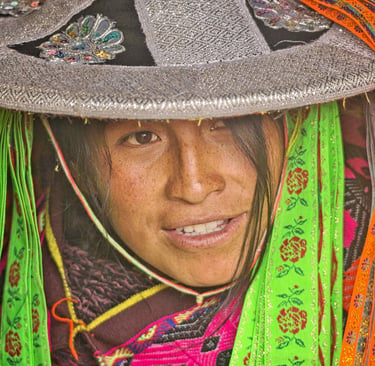
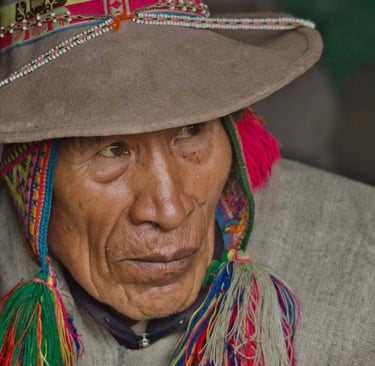
An elder’s face or a colorful garment can be visually striking, but neither tells the whole story.
Look for a person’s interests, work, humor, creativity, and choices. Include the context they consider important rather than expecting every participant to represent an entire culture.
Q’eros textiles: photograph the knowledge behind the cloth
Textiles are an important part of Q’ero cultural expression. The Ministry of Culture’s work on Q’ero weaving documents the importance of transmitting knowledge between generations, including through artisans’ demonstrations and teaching.
For photographers, this suggests a richer approach than photographing color alone.
Build a textile sequence
With permission, consider photographing:
The maker within the working space.
Hands carrying out an actual stage of work.
Materials and tools the maker explains.
A detail showing texture or construction.
A completed piece and how it is used.
The activity available during your visit may be only one part of the process. Do not imply that you documented every stage if you did not.
Ask about motifs and meaning
Do not invent a symbolic meaning for a pattern because it resembles something familiar.
Ask the artisan what they wish to explain, record the answer accurately, and avoid extending one person’s explanation to every textile or community.
If a design or practice should not be photographed or interpreted publicly, respect that preference.
Support work fairly
Buying a textile can be a meaningful way to support a maker, but a purchase does not automatically include a portrait or permission to reproduce the work for every purpose.
Agree separately on arranged sessions, demonstrations, and image use.
Photographing daily life without directing it
Daily-life photography depends on what is happening and what people are comfortable sharing.
Possible subjects may include textile work, household tasks, care of animals, or movement through the surrounding landscape. These should be possibilities discussed with hosts, not guaranteed performances.
A documentary photograph records an activity without directing it. An arranged portrait involves collaboration and positioning. A demonstration is organized to show a process.
All three can be valuable. Describe them honestly when the distinction matters.
Do not ask someone to repeat an emotionally significant moment or claim that a demonstration was an unobserved scene.
Best time for Q’eros photography: we travel year-round
We organize Q’eros photography tours throughout the year, adapting the plan to local arrangements and conditions.
There is no single season that is best for every photographer. Your preferred light and background should influence the conversation about dates.
In the southern Andes, a useful broad pattern is a relatively drier period from May to October and a wetter period from November to April. Seasonal boundaries vary, and the actual route needs local assessment.
Why many of our portrait clients enjoy the rainy season
For photographers who value atmosphere, the rainy season can be a creative choice.
Cloud-filtered light may reduce harsh facial shadows. Greener surroundings can give environmental portraits a different color palette, while occasional mist simplifies distant hills and creates separation around the subject.
Wet stone, earth, and vegetation may add texture. A sheltered doorway can become a portrait location when an outdoor session is interrupted.
This preference comes from our experience with clients; it is not a claim that all professional photographers favor the same conditions.
Misty portraits: work with what appears
Light mist can turn a complex background into softer shapes. Dense fog may remove the context entirely.
Adjust the composition to the conditions. A closer portrait may work when the mountains disappear; a wider frame may become useful when the cloud begins to lift.
Mist is not guaranteed, and rain does not follow a fixed visitor timetable.
The dry season offers different strengths
The drier months can suit travelers prioritizing clearer landscape context and simpler outdoor planning.
Early and late light can create warmth and texture. During stronger sunlight, open shade and agreed indoor spaces provide softer alternatives.
Dry season does not mean that every day is clear or that weather planning is unnecessary.
Season comparison for portrait photographers
PriorityRainy-season possibilitiesDry-season possibilitiesSoft outdoor lightMore opportunities under cloudUse shade or suitable times of dayLandscape moodMist and changing cloud where conditions allowClearer views and more defined mountain layersColorGreener surroundings in suitable areasDrier vegetation and warmer landscape tonesSession planningFlexible timing and sheltered alternativesOften more straightforward outdoor schedulingMain limitationRain, low visibility, and access changesHarsh sunlight and bright backgrounds
The right choice depends on the images you want and the flexibility you can allow.
Planning a rainy-season Q’eros visit
Year-round operation does not mean every road, path, or community visit is practical on every date.
A photography-focused plan should leave room to change a session, use shelter, or spend longer in a productive location. Avoid a schedule so tight that one weather delay affects every later activity.
People’s comfort comes first. Never ask someone to stand in cold rain simply to create an atmospheric image.
Natural light techniques for Q’eros portraits
Open shade
Find a shaded position facing an open area of light. Review the eyes and facial shadows rather than assuming all shade is equally useful.
Doorway light
A doorway can provide directional light while keeping the session sheltered. Ask permission to use the space and avoid blocking household activity.
Window light
Side light can reveal facial features and textile texture. Watch for a bright background or shadows that conceal the eyes.
Misty backgrounds
Keep enough separation between the person and the surroundings. A change in camera angle can help without asking the participant to move.
Strong sunlight
Change the timing or position where possible. Reflectors or flash should be used only when appropriate and agreed; a larger setup may change the nature of the encounter.
Camera equipment and settings
A compact, familiar kit is often easier to manage in changing weather and during conversations.
A standard zoom suits environmental portraits. A moderate telephoto can simplify a background from a comfortable distance. A wide lens can show context, but avoid moving so close that it distorts the face or feels intrusive.
Bring rain protection, dry storage, lens cloths, spare batteries, and memory cards.
SituationStarting approachStill portraitAround 1/250 second, with aperture selected for the required depth of fieldMoving hands or active workIncrease toward 1/500 second or faster as neededA group portraitUse enough depth of field and check all important facesA dim indoor sceneBalance aperture, ISO, and movementMisty environmental portraitExpose for the person while retaining useful background atmosphere
These are starting suggestions, not fixed prescriptions.
Focus on the eye when it is visible and central to the image. Review sharpness and highlights rather than relying only on the screen’s overall brightness.
RAW capture can provide flexibility for white balance and exposure adjustments.
Editing portraits and textiles with care
Keep skin tones believable and preserve texture in clothing.
Do not remove every sign of mist if atmosphere is part of the image. Equally, avoid adding dramatic haze or exaggerated color and presenting it as an unaltered record.
Be careful with alterations that change cultural context, clothing, or the apparent meaning of an activity.
Captions should distinguish what the person told you from your own interpretation.
Ceremonies, homes, and children
A community visit does not automatically include ceremonies or access to private spaces.
Discuss any special activity in advance, including whether photography is welcome and how the resulting images may be used. Accept restrictions without pressure.
For children, seek appropriate parent or guardian permission and respect the child’s willingness. Consider privacy before sharing identifiable images or household information.
A child’s participation should never be obtained through pressure or promises of gifts.
What to confirm before booking
Ask for a clear explanation of:
The communities and route proposed.
Walking distances, terrain, and sleeping arrangements.
Language support and guiding.
Meals, transport, and equipment requirements.
How portrait sessions or demonstrations are arranged.
Compensation and other local contributions.
Weather flexibility and access checks.
What is included and what remains optional.
Avoid choosing a tour only because it promises “exclusive access.” Good access means agreed participation and clear expectations.
Build a meaningful photo story
A varied sequence can communicate more than many similar portraits.
Begin with a view of the place, then include an agreed environmental portrait, a closer image, a relevant activity, and a detail explained by the participant.
Do not force every encounter into a fixed sequence. Follow the person’s interest, available time, and comfort.
When welcomed, show the photographs and ask whether a print or digital copy would be useful. Promise delivery only when you can follow through.
Frequently asked questions
Do you run Q’eros photography tours all year?
Yes. Photo Tours Peru organizes journeys throughout the year, with final routes and visits adapted to local participation, access, and conditions.
Is the rainy season a good time for portraits?
Yes. Many photographers who travel with us value its soft light, greener backgrounds, and possible mist. A flexible plan is important.
Is mist guaranteed?
No. Mist depends on local conditions and can change quickly.
Can I photograph weaving and textiles?
These can be important parts of the visit when participants agree. The activity and stage of work available will vary.
Can I photograph ceremonies?
Only when the relevant people agree and arrangements permit it. A booking does not automatically include a ceremony.
Is Q’eros suitable for beginner photographers?
Yes, when the travel and walking requirements match your needs. Familiarity with camera basics helps you concentrate on communication and composition.
Can I publish the portraits?
Discuss the intended use with participants. Permission to take a photograph should not be treated as agreement to every form of public or promotional use.
Plan your Q’eros photography journey with Photo Tours Peru
Tell us your dates, group size, camera experience, walking preferences, and the style of portraits you want to create.
If you are drawn to rainy-season mist, soft light, and greener settings, tell us when planning. We can discuss the route and alternatives around that preference.
Explore our Q’eros Andean Portrait Photography Expedition — 6 Days.
For a wider journey, explore our 10-Day Andean Portrait Photography Expedition.
Contact Photo Tours Peru to plan a year-round photography experience shaped by people, local knowledge, and the light you want to work with.


Contact
Email: phototourperu@gmail.com
Phone: +51 940188346
© 2025. All rights reserved.
Designed by Zihna