RAINBOW MOUNTAIN PERU: THE GEOLOGICAL STORY OF VINICUNCA AND ITS RISE AS A PHOTOGRAPHY DESTINATION
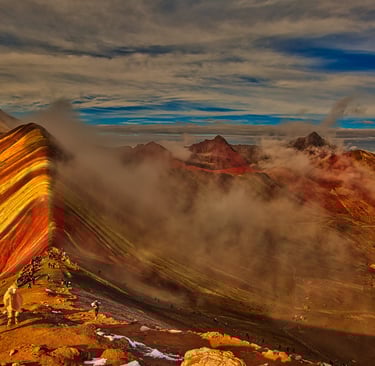
High in the Peruvian Andes, in the spectacular Cordillera Vilcanota, lies a landscape that looks almost impossible. Bands of red, pink, green, yellow, gold, white, and lavender sweep across the mountainside as if someone had painted the Andes with a giant brush. This is Vinicunca, better known internationally as Rainbow Mountain Peru, Mountain of Seven Colors, or Montaña de Siete Colores.
Photo tours peru
8/11/20269 min read
RAINBOW MOUNTAIN PERU: THE GEOLOGICAL STORY OF VINICUNCA AND ITS RISE AS A PHOTOGRAPHY DESTINATION
Vinicunca: A Mountain Painted by Millions of Years of Earth History
High in the Peruvian Andes, in the spectacular Cordillera Vilcanota, lies a landscape that looks almost impossible.
Bands of red, pink, green, yellow, gold, white, and lavender sweep across the mountainside as if someone had painted the Andes with a giant brush.
This is Vinicunca, better known internationally as Rainbow Mountain Peru, Mountain of Seven Colors, or Montaña de Siete Colores.
Located southeast of Cusco and within the dramatic landscape surrounding the sacred Ausangate massif, Vinicunca has become one of Peru's most recognizable natural landscapes.
But the colors are not a recent phenomenon.
The mountain itself is the result of an extraordinarily long geological history involving sedimentation, tectonic deformation, uplift, erosion, and mineral alteration.
What is recent is not the creation of Rainbow Mountain.
What is recent is the world's discovery of its image.
And that distinction is important.
WHERE IS RAINBOW MOUNTAIN?
Vinicunca is located in the Cordillera Vilcanota, southeast of Cusco, in one of the highest and most dramatic regions of the Peruvian Andes.
The mountain lies in the broader landscape associated with Ausangate, one of the most important sacred mountains, or Apus, of southern Peru.
The summit of Vinicunca is commonly reported at approximately 5,200 meters (17,060 feet) above sea level, although the exact elevation cited can vary depending on whether the reference is to the summit or the principal tourist viewpoint. The main hiking route itself reaches more than 5,000 meters, making this one of the highest-altitude tourist attractions in Peru.
The altitude is not simply a statistic.
It is one of the defining characteristics of the experience.
At this elevation, the landscape changes dramatically:
Vegetation becomes sparse.
The air is noticeably thinner.
Weather changes rapidly.
Solar radiation is intense.
Clouds can appear and disappear within minutes.
Snow and ice can occur even when the valleys below are warm.
For photographers, these conditions create something particularly valuable:
rapidly changing light.
THE GEOLOGICAL ORIGIN OF RAINBOW MOUNTAIN
To understand Vinicunca, we have to go back millions of years.
The Andes were not always the mountains we see today.
The rocks exposed around Vinicunca began as layers of sediment deposited in ancient environments influenced by water—including marine, lacustrine, and fluvial settings.
Different periods of deposition produced different sediments.
Mud.
Clay.
Sand.
Carbonate-rich material.
Mineral-rich sediments.
Over geological time, these materials became sedimentary rocks.
Research presented on the sedimentology of the Vinicunca area describes the region as being associated with complex sedimentary sequences and tectonic structures within the Vilcanota region. The geological history includes much older formations than the simplified “two million years” explanation sometimes repeated in tourism material.
This is important because Rainbow Mountain is not a single layer of colorful rock.
It is a landscape made from multiple geological layers with different compositions.
THEN THE ANDES ROSE
The next chapter was tectonic.
The Andes were progressively uplifted by the interaction of the Nazca Plate and South American Plate.
As tectonic forces compressed and deformed the Earth's crust, sedimentary layers that had originally accumulated in relatively horizontal environments were folded, fractured, tilted, and elevated.
What had once been buried layers became mountains.
The geological forces that created the Andes effectively transformed a hidden geological archive into a spectacular exposed landscape.
At Vinicunca, the different layers became visible across the slopes.
And that is the foundation of the rainbow effect.
WHY DOES RAINBOW MOUNTAIN HAVE SO MANY COLORS?
This is perhaps the most fascinating part of the story.
Vinicunca's colors are associated with differences in the composition of the sediments and rocks, together with processes such as oxidation, weathering, erosion, and exposure.
The Geological Society of Peru has been cited in Peruvian reporting as explaining the colors through a complex history of marine, lacustrine, and fluvial sediments, with oxidation and erosion contributing to the striking surface colors.
Different bands contain different combinations of minerals and sedimentary materials.
🩷 PINK AND FUCHSIA
Pink and reddish-pink tones are associated with combinations of red clay, mudstone/fine sediment and sand-rich materials.
These layers create some of the most spectacular bands visible from the main viewpoint.
❤️ RED
Red tones are strongly associated with iron-bearing clays and clay-rich sedimentary rocks.
Iron can oxidize when exposed to oxygen and moisture, producing reddish and rusty colors.
It is essentially a geological version of rust.
💛 YELLOW AND MUSTARD
Yellow, ochre, and mustard-colored bands are associated with limonitic and mineral-rich sedimentary materials, including calcareous sandstones with sulfur-bearing mineral components in some interpretations of the local geology.
💚 GREEN
Greenish bands are associated with ferromagnesian minerals and clay-rich materials, with copper-bearing components also cited in descriptions of the local mineral coloration.
🤍 WHITE AND CREAM
White and pale bands are associated with quartz-rich sandstone and carbonate-rich materials, including limestone/marl-type sediments.
💜 PURPLE AND LAVENDER
Lavender and purple tones can result from combinations of clay, carbonate-rich material, and silicate-bearing sediments.
The important point is that there is no single “rainbow mineral.”
The rainbow is the visual expression of multiple geological layers with different compositions and histories.
EROSION REVEALED THE PAINTING
Tectonic uplift alone did not create the landscape we photograph today.
Erosion played an equally important role.
Wind, rain, freeze-thaw processes, glacial activity, and other forms of weathering progressively removed and sculpted the surrounding material.
The result is a landscape where different geological layers are exposed at the surface.
From a distance, those layers appear as colored stripes.
From a photographer's perspective, however, they become something much more:
lines, textures, patterns, diagonals, layers, and natural color palettes.
DID CLIMATE CHANGE “CREATE” RAINBOW MOUNTAIN?
This is an area where tourism information is often oversimplified.
You will frequently see the statement that:
“Climate change created Rainbow Mountain.”
That is not scientifically accurate.
Climate change did not create the colored geological layers.
Those layers formed over vastly longer geological timescales.
However, changes in snow and ice cover can influence how much of the underlying landscape is exposed and visible.
As snow and ice retreat, previously covered geological surfaces can become much more apparent.
Therefore, it is more accurate to say:
The geological colors are ancient, while their recent exposure and visibility have been influenced by changes in snow and ice cover.
This distinction matters when telling the real story of Vinicunca.
WAS RAINBOW MOUNTAIN REALLY “DISCOVERED” IN 2015?
Not in the literal sense.
Local communities knew this landscape long before international travelers arrived.
The area is part of a culturally important Andean environment associated with Ausangate and traditional highland communities.
The idea that Vinicunca was “discovered in 2015” usually refers to the moment when its spectacular colored slopes began receiving enormous international attention.
Photography changed everything.
Images circulated through:
📱 Instagram
📱 Facebook
🌐 Travel websites
📺 Television
📸 Photography publications
🗺️ Online travel platforms
Suddenly, a remote Andean landscape became recognizable around the world.
So 2015 should be understood as a period of global visibility—not the physical discovery of the mountain.
Research and travel reporting place the explosion of international tourism in the mid-2010s, while the mountain had long been known locally.
FROM REMOTE ANDEAN LANDSCAPE TO GLOBAL PHOTOGRAPHY ICON
This transformation is one of the most interesting stories about Vinicunca.
For generations, the surrounding mountains were part of everyday life for local communities.
Then smartphones and social media created something completely new:
a remote landscape could become globally famous through a photograph.
One photograph led to another.
Travelers wanted to see the mountain they had seen online.
Tour operators began creating Rainbow Mountain tours from Cusco.
Hiking routes developed.
Infrastructure and visitor services expanded.
And Vinicunca became one of the most recognizable destinations in the Cusco region.
This is a perfect example of how visual media can transform a remote landscape into a global tourism destination.
WHY PHOTOGRAPHERS SEE VINICUNCA DIFFERENTLY
For a conventional traveler, Rainbow Mountain may be:
“A colorful mountain.”
For a photographer, it is an enormous natural composition.
Look carefully and you begin to see:
LEADING LINES
The colored bands naturally guide the eye through the frame.
DIAGONALS
The geological layers create powerful diagonal compositions.
COLOR CONTRAST
Red against green.
Gold against purple.
White against red.
Blue sky against saturated earth tones.
SCALE
A human figure, horse, alpaca, or distant hiker can provide scale and reveal just how enormous the landscape really is.
TEXTURE
Eroded sediment, gravel, rock, snow, and high-Andean vegetation create extraordinary foreground detail.
LAYERS
Vinicunca can be photographed as a single mountain—or as a series of overlapping geological and atmospheric layers.
RAINBOW MOUNTAIN FOR LANDSCAPE PHOTOGRAPHY
Vinicunca is particularly powerful for landscape photographers because the scene changes dramatically depending on light.
Under flat midday light, the colors may appear relatively subdued.
Under directional sunlight, the geological bands can become much more pronounced.
Cloud shadows can sweep across the slopes.
Sunlight can isolate individual ridges.
Mist can partially obscure the mountains and create atmospheric depth.
For this reason, photographers should not simply arrive, take one photograph from the main viewpoint, and leave.
The light is part of the experience.
WHY EARLY MORNING CAN BE SPECIAL
Early morning can provide:
🌄 Softer directional light
☁️ Atmospheric conditions
🏔️ Longer shadows
📸 Greater texture
👥 Potentially fewer visitors than later periods
However, weather is never guaranteed in the high Andes.
Clouds and snow can completely transform the appearance of Vinicunca.
And that is precisely why experienced landscape photographers embrace the uncertainty.
Sometimes the “perfect blue sky” produces a beautiful photograph.
Other times, the photograph with dramatic clouds, mist, and changing light is far more powerful.
RAINBOW MOUNTAIN AFTER A LIGHT SNOWFALL
One of the most dramatic conditions for photography is when snow partially covers the colored layers.
Instead of eliminating the colors, snow can create contrast between:
white snow + red earth + green bands + golden slopes + deep blue sky.
This can produce images that look completely different from the familiar postcard photograph.
VINICUNCA AND ASTROPHOTOGRAPHY
For Photo Tours Peru, this is where Rainbow Mountain becomes even more interesting.
The high altitude, remote setting, dramatic geological foregrounds, and limited artificial light make the surrounding region highly attractive for night landscape photography and astrophotography.
Imagine composing:
Milky Way + Rainbow Mountain + Andes
instead of photographing Vinicunca only during daylight.
The geological formations become a foreground beneath the night sky.
With careful planning, photographers can work with:
🌌 Milky Way landscapes
⭐ Star fields
🌄 Blue-hour transitions
🌙 Moonlit landscapes
✨ Long exposures
📸 Panorama sequences
The mountain becomes more than a daytime attraction.
It becomes an astronomical landscape.
RAINBOW MOUNTAIN AND THE SACRED ANDES
Vinicunca should also be understood culturally, not just photographically.
The mountain lies within a broader Andean landscape dominated by Apu Ausangate, a sacred mountain deeply connected to local Andean spirituality.
The surrounding region is also associated with the Qoyllurit'i pilgrimage, one of the most important religious and cultural traditions in the Peruvian Andes.
The landscape therefore represents much more than a colorful geological formation.
It is simultaneously:
geology + ecology + spirituality + culture + photography.
That combination is what makes the region extraordinary.
THE RAINBOW MOUNTAIN EXPERIENCE IS NOT JUST ABOUT THE SUMMIT
One of the biggest mistakes visitors make is focusing exclusively on the famous viewpoint.
The journey itself contains extraordinary photographic opportunities.
The high-altitude valleys.
Alpacas.
Llamas.
Quechua communities.
Glacial peaks.
Ausangate.
Rock formations.
Cloud shadows.
High-Andean vegetation.
Local people.
And the changing relationship between human life and an extreme mountain environment.
For a photography expedition, these elements are part of the story.
VINICUNCA: FROM TOURIST ATTRACTION TO PHOTOGRAPHY DESTINATION
The evolution of Vinicunca is fascinating.
FIRST:
A remote high-Andean landscape known primarily by local communities.
THEN:
Photographs began circulating internationally.
NEXT:
Travelers began arriving specifically to see the colorful mountain.
TODAY:
Vinicunca has become a major destination for hiking, landscape photography, travel photography, and increasingly specialized photography experiences.
And the next evolution is already happening.
Photographers are no longer satisfied with simply taking the same photograph everyone else has taken.
They want:
Different light.
Different seasons.
Different perspectives.
Different compositions.
Night skies.
Portraits.
Wildlife.
Cultural stories.
And images that communicate the scale and character of the Andes.
WHY PHOTOGRAPH RAINBOW MOUNTAIN WITH PHOTO TOURS PERU?
At Photo Tours Peru, we approach Vinicunca differently.
We don't want to take you to the viewpoint, give you ten minutes, and tell you to take the same photograph as everyone else.
Our objective is to help you see the landscape photographically.
We consider:
📸 Composition
☀️ Direction of light
🌄 Golden hour
🌌 Night-sky conditions
☁️ Weather and atmospheric conditions
🏔️ Mountain scale
🦙 Wildlife and human elements
📷 Lens selection
🧭 Alternative viewpoints
⛰️ High-altitude conditions
Our Rainbow Mountain photography tours in Peru are designed for photographers who want more than a sightseeing experience.
They are designed to create images with:
depth, scale, atmosphere, color, and story.
THE FUTURE OF RAINBOW MOUNTAIN PHOTOGRAPHY
Vinicunca has already become one of Peru's most photographed landscapes.
But the best photographs are not necessarily the ones taken from the most famous viewpoint.
The future of Rainbow Mountain photography is about exploration and interpretation.
Instead of asking:
“Where can I take the famous Rainbow Mountain photo?”
we ask:
“How can I create a photograph that tells the story of this landscape?”
That could mean photographing the geological bands at sunrise.
It could mean including an Andean herder to communicate scale.
It could mean creating an intimate abstract composition from the mineral textures.
It could mean photographing Ausangate behind Vinicunca.
Or it could mean waiting until darkness falls and photographing the Milky Way above the colored Andes.
VINICUNCA: A PHOTOGRAPH OF DEEP TIME
Perhaps the most extraordinary thing about Rainbow Mountain is this:
When you look at the colored bands, you are not simply looking at a beautiful landscape.
You are looking at geological time.
Sediments accumulated.
Environments changed.
Minerals formed.
Rocks were buried.
The Andes rose.
The layers were folded and exposed.
Ice and water shaped the landscape.
Erosion revealed the colors.
And millions of years later, a photographer stands in front of the mountain with a camera.
That is the real story of Vinicunca.
The photograph may take one second to make.
The landscape took millions of years to create.
EXPERIENCE RAINBOW MOUNTAIN THROUGH PHOTOGRAPHY
Join Photo Tours Peru on a specialized Rainbow Mountain photography tour and experience Vinicunca not simply as a tourist attraction, but as a living geological and cultural landscape.
📍 Vinicunca – Rainbow Mountain, Cusco, Peru
📸 Landscape Photography
🌌 Astrophotography
🏔️ Andean Photography
🦙 Cultural & Travel Photography
🎒 Private Photography Tours
📷 Photography Expeditions in Peru
Come for the colors.
Stay for the light.
Leave with photographs that tell the story of the Andes.


Contact
Email: phototourperu@gmail.com
Phone: +51 940188346
© 2025. All rights reserved.
Designed by Zihna